The verdict
One of five plain-language verdicts and a sentence naming the main consequence. No score hides which clause led to it.
 Policy PalAdd Policy Pal to Chrome
In shortPolicy Pal identifies consequential clauses, answers eight fixed questions, and gives you the source quote behind each stated claim.
Policy Pal gives you the decision-relevant answer first. Read the finding, understand its consequence, then check the quoted sentence beside the original page.
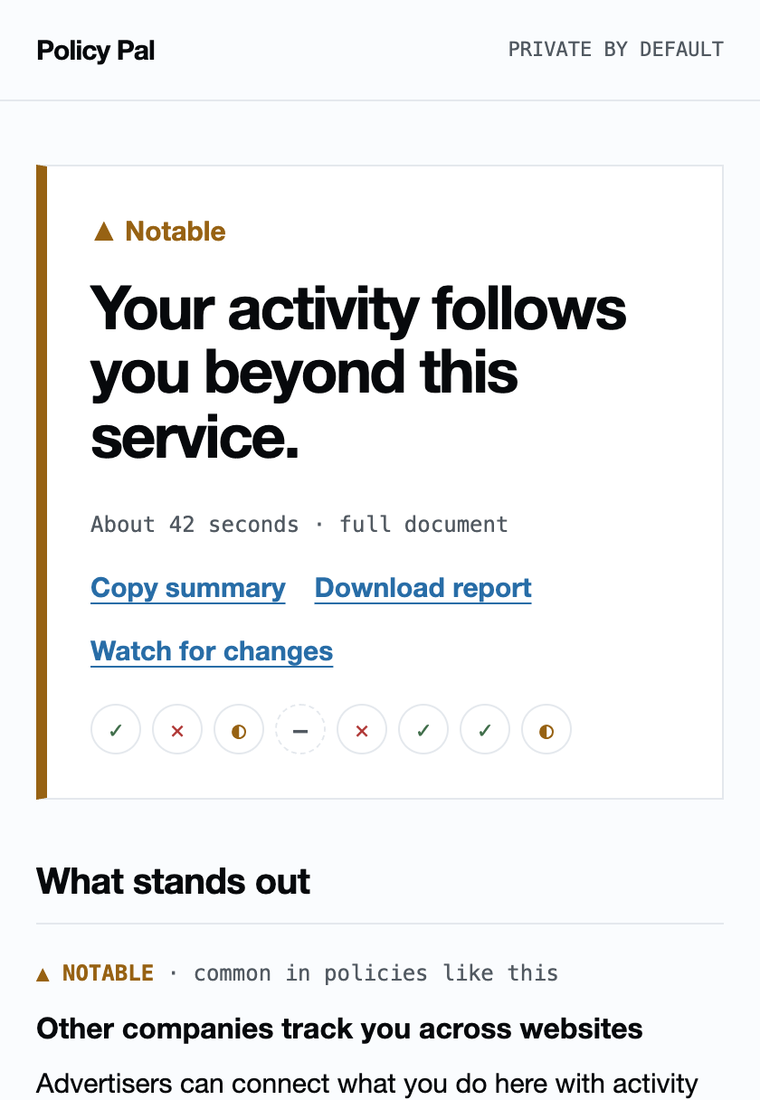
One of five plain-language verdicts and a sentence naming the main consequence. No score hides which clause led to it.
Up to five clauses worth a second look. Each explains the consequence for you and says whether the term is common, uncommon, or rare.
Open a finding to see its source quote, then use Find it on the page to check that sentence in the live document.
Eight fixed questions for each kind of policy, answered yes, no, partly, or not stated. A missing promise stays a silence.
Before a report reaches you, Policy Pal normalises the source document and checks that every quote appears in it verbatim. A claim whose quote cannot be found is discarded rather than softened. That is why a report sometimes has two findings instead of five — and why an honest unclear verdict exists at all.
Rankings differ between documents. These do not. Privacy policies and cookie policies are answered against one fixed set; terms of service against another.
With Premium, choose Watch for changes from a public policy’s report. Policy Pal re-reads watched pages and marks the browser icon when one of the eight fixed answers moves; the panel shows what changed. It does not email you or alert you to every wording edit.
Premium puts a report’s answers in context with other documents of the same kind. When fewer than 30 comparable documents have been read, Policy Pal says the baseline is unavailable. The extension does not rank companies or assign a privacy score.
Premium accepts pasted text, a TXT file, or a PDF with a readable text layer in a dedicated extension tab. You see the extracted text before sending it. The file stays in your browser; only the report is retained for 30 days. A scan without selectable text is refused rather than guessed from an image.
Anyone can copy a short summary with its source quotes. Premium can download the full report as Markdown, including the quotes, document address, reading date, and disclaimer. See what each plan includes.
Policy Pal reads English documents, not scanned images or every page you visit. Its automated report can be incomplete or wrong and is not legal advice. It gives no numeric score and cannot promise it found everything. The source sentences let you check its reading and decide what to do next.
The welcome page shows a sample report, so you know what you are getting. Your 1 free analysis is there for the policy in front of you rather than for a demonstration.